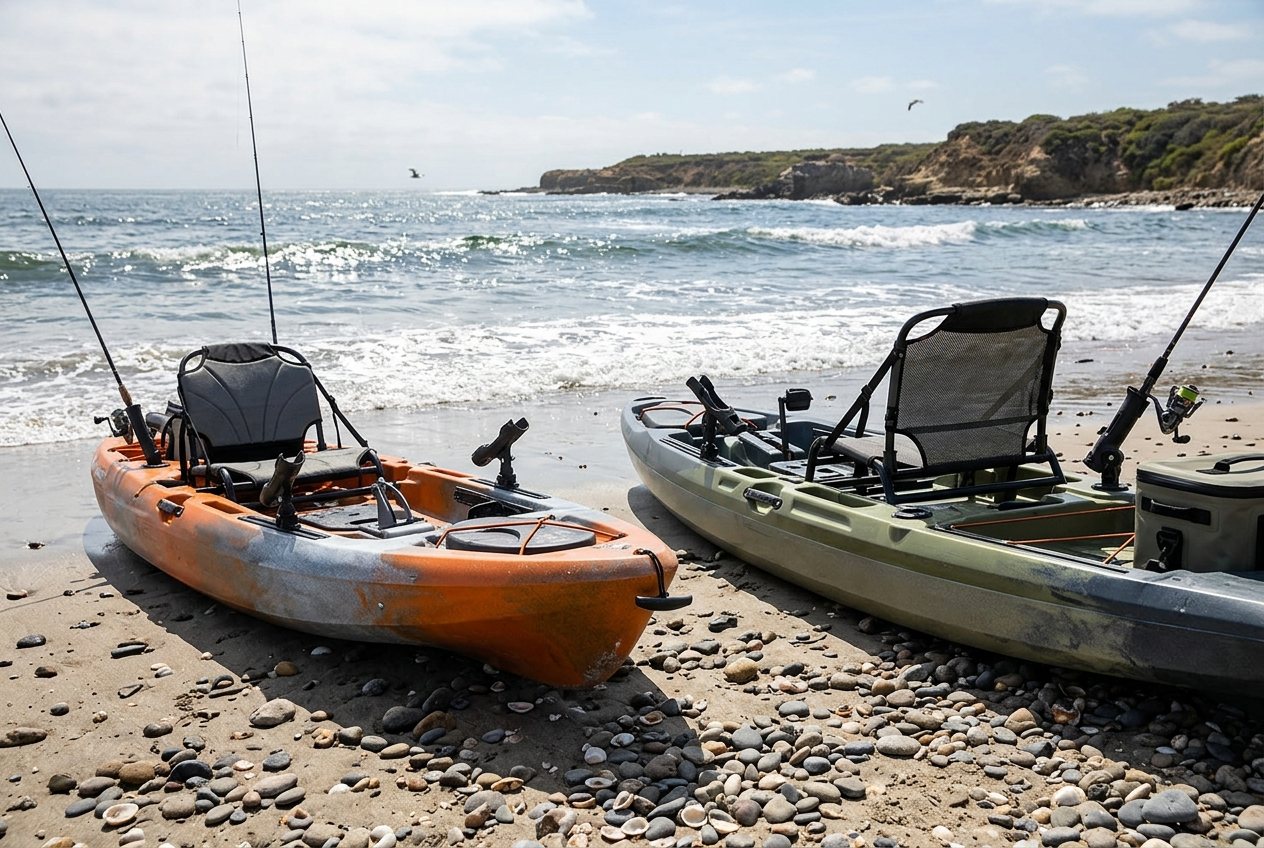
Sit-on-Top vs. Hybrid Fishing Kayaks for Ocean Use Compared
Why kayak style matters more offshore
On a lake, the difference between kayak styles is mostly comfort. In ocean surf, current, and swell, that difference becomes a safety and functionality question. A kayak that feels stable and dry on flat water can behave very differently punching through a wave or when you need to climb back aboard after a capsize a half mile from the beach. This comparison looks at the main hull styles anglers use for ocean fishing — sit-on-top, hybrid (sit-on-top with a lowered seating well), and pedal-drive sit-on-tops — against the demands specific to saltwater launches: surf handling, self-rescue, storage for rigged gear, and how the kayak tracks in wind and current.
None of these styles is universally correct. The right choice depends on your typical launch (beach versus calmer inlet), how far you paddle or pedal offshore, and how much gear you carry rigged and ready.
What ocean use actually demands
A few things separate ocean-going fishing kayaks from flatwater recreational boats, regardless of style:
- **Self-bailing scuppers.** Water that comes over the deck in surf needs somewhere to go. Scupper holes that drain to the waterline are close to essential for regular ocean use.
- **Re-entry ability.** You should be able to climb back onto the kayak from the water without swamping it, ideally without assistance.
- **Secondary stability.** Initial stability (how steady it feels sitting still) matters less offshore than secondary stability — how the hull behaves when it's tilted by a wave or a hooked fish pulling hard to one side.
- **Storage that stays rigged.** Rod holders, crates, and anchor trolleys need to survive repeated surf launches without shifting or filling with sand.
Keep these in mind as you compare styles below, since a boat that scores well on paper but lacks self-bailing scuppers is a poor match for beach launches with any real surf.
Style comparison
| Factor | Sit-on-top (paddle) | Hybrid (lowered well) | Pedal-drive sit-on-top |
|---|---|---|---|
| Surf handling | Generally good; open deck sheds water easily | Can hold water in the well during a wash-over | Good, but drive unit adds a snag point in shallow surf |
| Re-entry / self-rescue | Straightforward; flat deck gives clear hand and knee positions | More difficult; the recessed seat well can trap water and complicate climbing back in | Similar to sit-on-top, but the pedal drive housing can be in the way |
| Storage for rigged gear | Ample open deck space for crates, rod holders, trolleys | Slightly reduced deck space due to the seating well | Deck space often good; hull space is reduced by the drive mechanism |
| Hands-free fishing | Requires stopping to paddle when changing position | Same as paddle version | Best option for hands-free positioning while fishing |
| Wind and current tracking | Adequate; some models drift more without a rudder | Similar to standard sit-on-top | Often improved with a rudder paired to the drive, useful in current-heavy inlets |
Sit-on-top (paddle) kayaks
The open-deck sit-on-top is the most common style for ocean fishing, and for good reason. Water that comes aboard drains through the scupper holes rather than pooling around your legs, and the flat deck gives you a clear surface to climb back onto if you go over. These boats are usually simpler mechanically, which matters when sand and salt are working against every moving part. The tradeoff is that both hands are needed for paddling, so positioning the kayak while fighting a fish or working a spot takes more coordination than with a hands-free option.
Hybrid kayaks with a seating well
Hybrid designs lower the seat into a recessed well, which can feel more secure and comfortable for long sits, particularly on calmer water. In ocean conditions, though, that same well can collect water that came over the side, adding weight and making a self-rescue more awkward — you're now climbing over a rim into a depression rather than onto a flat surface. Hybrids tend to suit anglers who launch from calmer inlets or protected bays rather than open beach breaks, where the well's drawbacks matter less.
Pedal-drive sit-on-tops
Pedal-drive kayaks trade some hull volume and simplicity for hands-free propulsion, which is valuable when you want to hold a rod, work a lure, or adjust position while fighting a fish. Many pedal models also pair with a hand or foot-controlled rudder, which helps with tracking in the wind and current common around inlets and points. The drive unit itself is a mechanical component exposed to sand and salt, so it needs regular rinsing and occasional maintenance, and it can catch on structure or shallow bottom during a beach launch through modest surf.
Matching style to your launch
If most of your fishing starts with a beach launch through active surf, a straightforward paddle sit-on-top with reliable scuppers and a flat re-entry deck is the safer starting point. If you mostly launch from a calmer ramp or inlet and want to fish hands-free, a pedal-drive model earns its added complexity. Hybrid designs are worth considering mainly where launches are sheltered and self-rescue is a secondary concern rather than a routine expectation. Whichever style you choose, confirm the specific model's scupper design and re-entry behavior before committing to regular ocean use — those details vary more between individual boats than the general style category would suggest.