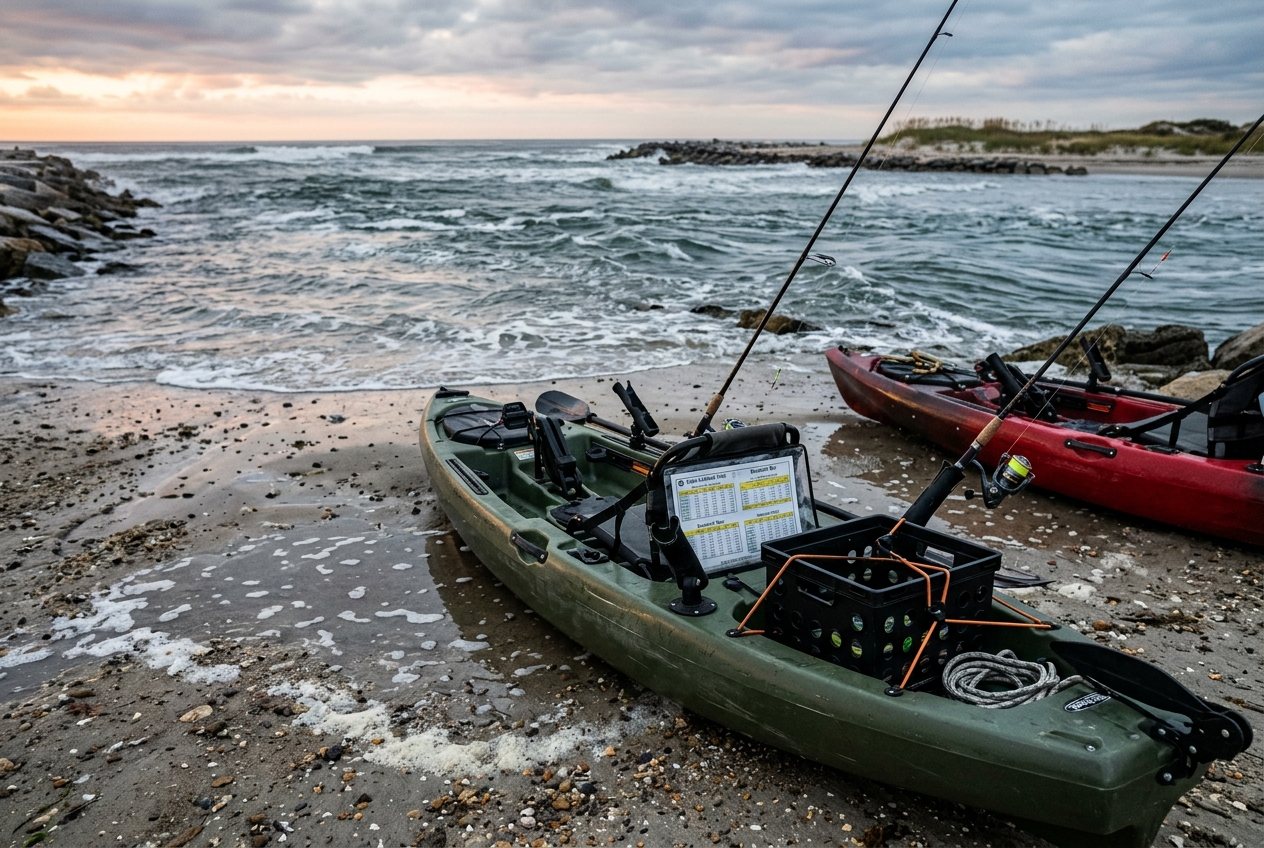
Reading Tides and Current at Ocean Inlets Before You Paddle Out
Inlets concentrate everything that makes ocean kayak fishing productive and everything that makes it dangerous. Water funnels through a narrow gap, current speeds up, structure holds bait, and predators stack up to feed. That same funneling effect can turn a calm-looking morning into a standing wave field the moment the tide turns against the wind or swell. Before you launch anywhere near an inlet, you need a habit of checking tide stage and current direction, not just a glance at the sky.
This is a pre-trip checklist, not tide theory. The goal is to give you a repeatable routine you can run through in five minutes at home and confirm again once you're standing at the launch.
Start With the Tide Chart, Not the Weather App
Pull the tide chart for the inlet you're fishing, not the nearest beach or harbor with a similar-sounding name. Inlets can have their own listed station, and even a few miles of coastline can shift high and low tide times meaningfully. Look for three things:
- **Time of the next high and low tide** relative to when you plan to launch and return.
- **Tide range** for that day. A run between a very high high and a very low low moves a lot more water, and faster, than a smaller swing.
- **Current tables**, if the station provides them separately from tide height. Slack water and maximum current don't always line up with high and low tide, especially in inlets with long channels or bays behind them.
If the only data available is tide height, treat mid-tide (roughly halfway between high and low) as the likely window for the strongest current, and plan around it until you've confirmed the pattern yourself.
Know Which Way the Water Is Moving
Tide stage tells you height. Current direction tells you what the water is actually doing, and at an inlet, that's the more important number for both safety and bite.
- **Flood tide** pushes water in from the ocean toward the bay or river mouth.
- **Ebb tide** pushes water out from the bay or river toward the ocean.
Ebb current flowing out against incoming ocean swell is the classic recipe for standing waves and a rough, occasionally dangerous inlet mouth. Wind against tide makes this worse in either direction. Before you commit to launching, check the tide table for whether you'll be paddling out during a flood or an ebb, and cross-reference it with the wind and swell forecast for the same window.
Match Conditions to Your Plan, Not the Other Way Around
A practical rule: pick your launch and return times around the tide, not around your schedule. If ebb tide at your inlet reliably produces rough water when wind and swell line up against it, don't launch into that window and hope it stays manageable. Shift your trip to slack water or an incoming flood instead.
Slack water, the short period around high or low tide when current direction is changing and speed drops close to zero, is usually the calmest and most forgiving time to cross an inlet mouth. It's a reasonable default for less experienced paddlers or for days when conditions are already borderline for other reasons.
Read the Water When You Arrive
Charts and tables give you a forecast, not ground truth. Confirm what you see before you launch:
- **Watch the surface for current lines.** Foam, debris, or a visible seam in the water often marks where two currents meet or where an eddy forms behind a jetty or point.
- **Check a fixed object.** A piling, buoy, or rock at the edge of the channel will show you current speed and direction more honestly than any app.
- **Look at wave behavior at the mouth.** Waves that appear to be stacking up, steepening, or breaking further offshore than usual are often a sign of outgoing current meeting incoming swell.
- **Give yourself a buffer.** If the water at the launch doesn't match what the tables suggested, trust what you're looking at and adjust your plan rather than the forecast.
Tie Current to the Bite, Carefully
Current has a real effect on where and when fish feed near an inlet, since it's what moves bait through structure and along drop-offs. Moving water, in general, tends to trigger more active feeding than dead slack, and many anglers plan trips around the last part of an incoming or outgoing tide for that reason. But the specific timing that works best can vary by inlet, season, and target species, and it's the kind of local pattern that's worth confirming with anglers who fish that particular water rather than assuming it carries over from somewhere else.
What you can rely on more broadly is the safety side of the equation: current strength and direction, not bite quality, should be the deciding factor in whether and when you cross an inlet mouth in a kayak.
A Simple Pre-Launch Routine
Before every inlet trip, run through the same short list:
1. Confirm tide times and range for the specific inlet station.
2. Identify whether your launch and return windows fall on flood, ebb, or slack.
3. Check wind and swell direction against that current direction.
4. Watch the water at the launch and adjust your plan if it doesn't match the forecast.
5. Choose slack water or a favorable flood if conditions are marginal in any other way.
Inlets reward preparation more than most other places you'll fish from a kayak. Treat the tide chart as the first piece of gear you check, not an afterthought once you're already on the sand.