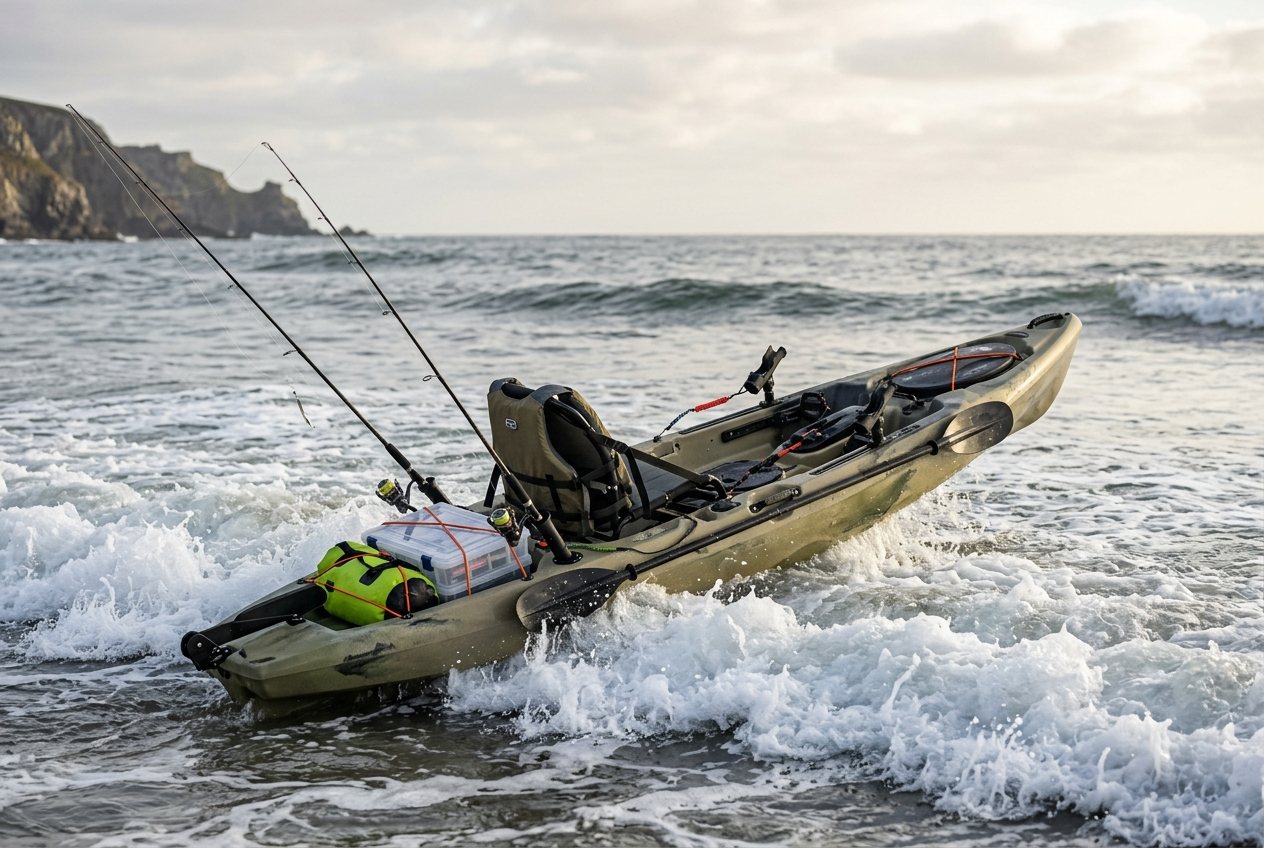
Launching a Fishing Kayak Through Surf Without Losing Your Gear
Why the Surf Zone Is Where Trips Go Wrong
Most kayak fishing problems that happen offshore actually start at the beach. A missed timing window, a kayak turned sideways by a wave, or a rod left loose in a holder can end a trip before you clear the break. Surf launches reward patience and a clear sequence more than strength or a fast paddle stroke. This guide walks through that sequence: reading the surf, staging your gear, launching, and coming back in.
Read the Surf Before You Touch the Water
Spend five full minutes watching the water before you carry your kayak down. Waves arrive in sets, usually with a few larger waves followed by a lull of smaller, more manageable water. Count the waves in a set and time the gap between sets. That gap is your launch window.
Look at how waves are breaking along the beach, not just directly in front of you. A section with a slightly deeper channel, often marked by darker water and less foam, will usually offer an easier path out than the sandbar next to it. Rip currents, which move water back out to sea, often run through these channels — useful for an assisted paddle out, but worth recognizing so you're not surprised by the pull.
Wind matters as much as wave height. Onshore wind steepens waves and shortens the interval between them. Wind blowing offshore can flatten the face of a wave but also makes it harder to hold position once you're past the break. If conditions look larger or messier than what you're comfortable handling, treat that as useful information rather than a challenge to push through.
Stage Your Kayak and Gear on the Beach
Rig as much as possible before you're in the water. Rods should be seated fully in flush-mount holders or rail-mount holders with the reels engaged, not just resting across the deck. Anything loose — a tackle bag, a paddle leash, a water bottle — should be clipped in or stowed in a hatch. A wave that floods an open cockpit will happily take anything not secured with it.
Double-check your leash setup: paddle leash, rod leashes if you use them, and a PFD that's already on and buckled, not stored under a bungee for later. Once you're moving toward the water, you should have nothing left to adjust.
Carry or wheel your kayak to the point where the wash reaches your ankles, not further. Point the bow toward the waves and hold it steady while you make your final read of the set pattern.
Launching: Timing and Positioning
Wait for the lull after a set passes. When you see it, walk the kayak forward, straddle the seat, and get seated in one motion rather than climbing on slowly from the side. Time spent fumbling for position is time the next set is using to arrive.
Paddle with firm, continuous strokes straight into the waves, keeping the bow pointed directly at oncoming water. A kayak angled even slightly sideways to a wave is far more likely to be pushed over or spun around. If a wave is breaking as it reaches you, lean forward and paddle through the whitewater rather than bracing back — leaning back is a common instinct that makes it easier for a wave to flip the kayak.
For larger waves that haven't broken yet, a forward lean paired with a strong paddle stroke will usually let you punch through the face. If you see a bigger wave building that you won't clear in time, it's sometimes better to hold position in the trough and let it pass in front of you rather than paddling directly into the impact zone.
Keep paddling until you're clearly past where waves are breaking, not just past the first line of whitewater. Conditions closer to shore can look calmer than they are simply because you're between sets.
Coming Back Through the Surf
Landing deserves the same attention as launching. Watch the pattern from the water before committing, and choose your angle of approach the same way you chose your launch channel.
Paddle in on the back of a wave rather than trying to out-paddle one that's about to break directly behind you. Keep the bow pointed straight toward the beach and continue paddling as the wave carries you in — stopping your strokes partway through invites the kayak to turn broadside.
As you near the beach, be ready to exit quickly once the hull touches sand. Step out on the side away from breaking waves if possible, and pull the kayak up past the wash line before dealing with gear or rods. A kayak left sitting in the wash can be caught and rolled by the next wave.
If You End Up in the Water
Practice a wet exit and re-entry in calm conditions before you ever need one in surf. If you do capsize near the break, hold onto your kayak and paddle if you can, keep your feet up and pointed downstream of the kayak to avoid foot entrapment on any rocks or structure, and move toward the beach rather than trying to re-board immediately in the impact zone. Re-entry is far easier once you're in calmer water beyond the break or safely in the shallows.
Building the Skill Over Time
Surf launches improve with repetition in small, manageable conditions before you attempt larger days. Practice on days with modest wave heights, focus on the sequence rather than speed, and treat any day that looks beyond your comfort as a day to fish from a different launch point instead.